
Dating Women From Kazan: Culture, Bicultural Identity, and Relationships in Russia’s Tatar Capital
Kazan is one of Russia’s most genuinely interesting cities, and one of its most overlooked by people whose mental map of the country runs primarily between Moscow and St. Petersburg. It sits on the Volga River roughly 800 kilometers east of Moscow, at the point where the river bends south toward the Caspian Sea, and it is the capital of the Republic of Tatarstan — a region that has maintained a distinctive identity within the Russian federation in ways that make Kazan something genuinely different from a typical Russian provincial city. Understanding what Kazan actually is helps considerably in understanding the women who come from there.
A City That Is Genuinely Two Things at Once
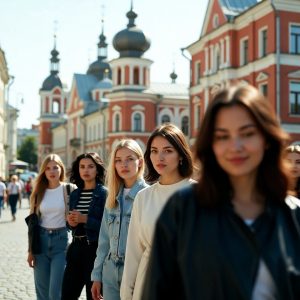
The most immediately striking thing about Kazan is that it functions as a genuinely bicultural city rather than a city with a dominant culture and a tolerated minority. The Kazan Kremlin — a UNESCO World Heritage site — contains both the Annunciation Cathedral, an Orthodox church built in the sixteenth century after Ivan the Terrible conquered the Kazan Khanate, and the Qol Sharif Mosque, one of the largest in Europe, rebuilt in 2005 on the site of a mosque destroyed during the original conquest. These buildings coexist within a few hundred meters of each other as a visual statement of what the city actually is: a place where Russian Orthodox and Tatar Muslim cultures have shared space for five centuries and developed, over that time, a specific mode of coexistence that is neither assimilation nor parallel separation but something more genuinely intertwined.
Tatars make up roughly half of Kazan’s population of 1.3 million, with ethnic Russians making up most of the remainder. Both Tatar and Russian are official languages of the Republic of Tatarstan, and many Kazan residents are functionally bilingual. This linguistic and cultural duality is visible in everything from street signs to restaurant menus to the way people navigate between cultural registers in daily conversation.
What the City Produces in Its Women
Women from Kazan tend to carry this bicultural identity in specific and recognizable ways. There is a warmth and hospitality that reflects the Tatar cultural tradition — Tatar hospitality toward guests is genuine and substantial, expressed through food, time, and a specific attentiveness that is distinct from the more formal hospitality of northern Russian cities. Alongside this is an intellectual orientation that reflects Kazan’s status as one of Russia’s significant university cities: Kazan Federal University, founded in 1804, is one of Russia’s oldest and most respected institutions, with a particularly strong tradition in mathematics, chemistry, and natural sciences. The mathematician Nikolai Lobachevsky developed non-Euclidean geometry here. The chemist Alexander Butlerov established the theory of chemical structure here. This academic tradition is part of the city’s identity in ways that produce women who take education and intellectual engagement seriously as baseline expectations rather than admirable extras.
Women from Kazan also tend to have a grounded, practical quality that comes from a city that has always had to manage complexity — cultural, linguistic, political — with pragmatism rather than ideology. The ability to navigate between different cultural frameworks without losing a clear sense of personal identity is something Kazan women often demonstrate in ways that Western men find both impressive and occasionally difficult to read until they understand the cultural context behind it.
Religion, Family, and What to Expect
The religious diversity of Kazan means that the women you meet there may come from Orthodox Christian, Muslim, or secular family backgrounds, and the cultural expectations around relationships vary accordingly. Muslim Tatar families tend to have stronger expectations around family involvement in relationship decisions and somewhat more traditional gender role expectations than secular or Orthodox families, though there is enormous individual variation. The most useful approach is to ask and listen rather than to assume based on a surname or ethnicity.
What is consistent across backgrounds is the centrality of family — Kazan’s social culture, whether Tatar or Russian in its specific expression, places genuine weight on family connections and family approval in serious relationships. Meeting her family is not a bureaucratic milestone but a meaningful step that both people take seriously, and approaching it with genuine warmth and interest in her family’s specific history tends to matter considerably.
Practical Guidance for Western Men
A few things that matter practically when dating women from Kazan. Learning even basic phrases in both Russian and Tatar — and knowing which to use when — communicates a level of cultural engagement that is genuinely unusual and genuinely appreciated. Understanding that Tatar and Russian cultural expectations may differ in specific ways, and approaching that complexity with curiosity rather than trying to flatten it into a single framework, reflects the kind of intellectual honesty that the city’s bicultural character tends to reward. Kazan women who have grown up navigating between two cultural worlds tend to have particularly well-developed instincts for detecting when someone is genuinely engaging versus when they are performing engagement, and the distinction matters.
The Universiade of 2013 and the various international sporting events hosted in Kazan have given the city more international exposure than most Russian provincial cities, which means that women from Kazan are somewhat more accustomed to Western visitors and somewhat more internationally oriented than their counterparts in smaller cities. This works in your favor as long as you bring genuine substance rather than relying on novelty alone, which wears off considerably faster in a city with more international exposure.
The Bottom Line
Kazan offers something genuinely unusual in the landscape of Russian cities: a place where cultural complexity has been managed over centuries through actual coexistence rather than the erasure of one culture by another. The women who come from this environment tend to be warm, educated, practically intelligent, and comfortable with complexity in ways that reflect their city’s specific character. Engaging with Kazan as the genuinely distinctive place it is — knowing something about the Tatar language, about the Kremlin’s dual character, about what it means to live in a city where two cultures have genuinely shared space for five centuries — communicates the kind of real interest that women from genuinely interesting places tend to find genuinely valuable.