

Montenegrin Women
Montenegro is one of Europe’s smallest and most scenically dramatic countries — a place where the Adriatic coast, the Dinaric Alps, and some of the deepest canyons on the continent exist within a territory smaller than Connecticut. It is also one of the more overlooked destinations for international dating, which means that Western men who make the effort to actually understand it tend to make a strong impression simply by having bothered. Montenegrin women combine Balkan warmth and directness with a strong sense of national pride rooted in a history of stubborn independence, and understanding that combination is the starting point for any relationship worth pursuing there.
Geography, Cities, and the Landscape That Shapes Daily Life
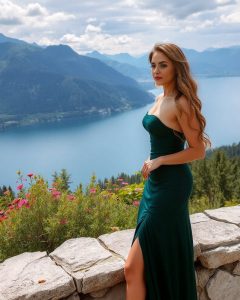
Montenegro declared independence from the State of Serbia and Montenegro in 2006, making it one of Europe’s newest sovereign states. It borders Serbia to the northeast, Bosnia-Herzegovina to the northwest, Albania to the southeast, Croatia to the west, and Kosovo to the east, with a short but spectacular Adriatic coastline to the southwest. The country divides sharply between its coastal strip and its mountainous interior, and these two zones produce genuinely different cultural environments.
The coast — Kotor, Budva, Bar, Herceg Novi — is defined by Venetian and Austro-Hungarian architecture, tourism, a Mediterranean pace of life, and summer seasons that bring significant international traffic. Kotor’s walled old town is a UNESCO World Heritage site and one of the best-preserved medieval fortifications on the Adriatic. Women from the coastal cities tend to be more internationally oriented, accustomed to foreign visitors, and comfortable switching between languages and cultural contexts.
Podgorica, the capital, sits in the interior and functions as the country’s political and commercial centre. It is a young city in historical terms — heavily damaged during World War II and largely rebuilt — with a university, government institutions, and a growing private sector. Cetinje, the old royal capital in the mountains above the coast, holds a different kind of significance: it was Montenegro’s capital during the era of the Petar II Petrović-Njegoš, the prince-bishop and poet who remains the central figure in Montenegrin cultural identity. The mountain towns — Kolašin, Žabljak near the Durmitor massif — maintain stronger ties to rural tradition and are surrounded by national park landscapes that most Montenegrins take genuine pride in.
History, National Identity, and What Shapes Montenegrin Women’s Values
Montenegro’s history is built around a narrative of small-country independence against much larger powers, and that narrative is not exaggerated. The Ottoman Empire never fully subdued Montenegro despite centuries of trying, and the country’s mountain clans maintained a degree of autonomy that is essentially without parallel in the broader Balkan region. The Petrović-Njegoš dynasty that ruled from Cetinje from the seventeenth century until 1918 produced a cultural and military tradition that Montenegrins reference with genuine pride rather than historical nostalgia.
The twentieth century was complicated. Montenegro was incorporated into Yugoslavia after World War I, occupied during World War II, and emerged from the Yugoslav period as one of the smallest and least economically developed of the former Yugoslav republics. The 1990s brought the difficult period of the Milošević era, international sanctions, and eventual separation from Serbia through the 2006 independence referendum. EU candidate status, which Montenegro has held since 2010, shapes the country’s current political trajectory toward eventual European integration.
What this history produces culturally is a strong orientation toward self-reliance, a preference for people who demonstrate substance over those who merely perform it, and a sense of national identity that is taken seriously without being aggressive about it. Montenegrin women carry these characteristics into relationships in specific ways: they tend to be direct rather than circuitous, loyal once trust is actually established rather than extended freely at the outset, and largely unimpressed by charm that is not backed by consistent behavior over time.
Culture, Family, and What Actually Matters Day to Day
Family is the primary social institution in Montenegro in ways that reflect both Balkan tradition and the specific history of a country where clan loyalty was often the difference between survival and its alternative. Extended family networks remain close and genuinely involved in each other’s lives, family gatherings are regular and important, and a serious relationship almost always eventually involves integration into each other’s family worlds rather than the two partners existing in an isolated bubble.
The slava — the Orthodox family patron saint day celebration, observed similarly across Serbia, Montenegro, and other Orthodox Balkan cultures — is one of the most important annual events in many Montenegrin families. It involves specific foods, specific rituals, and an open-house approach to hospitality where extended family, friends, and neighbors come and go throughout the day. Being invited to a family slava is a genuine signal of how seriously you are being taken. Approaching it with real warmth and interest rather than polite tolerance makes a lasting impression.
Hospitality is a genuine cultural value rather than a social performance. Coffee, food, and rakija — the fruit brandy that serves as Montenegro’s universal social lubricant — are offered with real generosity, and accepting them with genuine appreciation rather than polite deflection is the socially correct response. Traditional Montenegrin food reflects both Balkan and Mediterranean influences: grilled meats, fresh fish on the coast, cicvara (a cornmeal and cheese dish from the mountains), and njeguški pršut, a dry-cured ham from the village of Njeguši near Cetinje that is genuinely excellent and something Montenegrins are correctly proud of.
Education, Professional Life, and Independence

Montenegro is a small country with a correspondingly small economy, which means that education and professional versatility matter considerably to people building careers there. The University of Montenegro in Podgorica is the primary institution, and a significant number of Montenegrin students study abroad — in Serbia, other EU countries, and increasingly further afield — returning with international experience and expanded expectations. Tourism management, business, education, technology, and increasingly finance attract ambitious students, and women are well-represented across these fields.
The practical implication for relationships is familiar from other Eastern European contexts: Montenegrin women who have built or are building careers expect those careers to be taken seriously rather than treated as something to be accommodated until the relationship takes priority. A partner who engages genuinely with her professional life, supports her ambitions without making them feel like a concession, and brings his own parallel seriousness to the relationship tends to make a much stronger impression than one who expects her professional side to naturally recede as the relationship deepens.
Intellectual engagement matters. Montenegro’s cultural tradition — shaped significantly by the literary and philosophical legacy of Njegoš, whose epic poem The Mountain Wreath remains the central text of Montenegrin cultural identity — places real value on substance in conversation. A partner who can engage seriously across topics, who brings genuine curiosity rather than performed interest, and who treats her as someone worth debating with rather than simply impressing tends to build connection faster than one who relies on romantic gestures alone.
What Montenegrin Women Are Like in Relationships and Practical Guidance
Montenegrin women tend to be direct and take a while to fully open up — two things that go together more logically than they might initially seem. The directness means you will generally know where you stand rather than spending months interpreting ambiguous signals. The reserve in early stages means trust is something built through demonstrated reliability rather than extended in response to charm or enthusiasm. Both of these are straightforwardly useful qualities in a partner, even if the combination requires some patience to navigate at the beginning.
Reliability matters more than romance in the practical sense that keeps relationships going. A partner who does what he says he will do, who communicates clearly about his intentions rather than keeping things deliberately vague, and who shows consistent respect for her family and her time tends to make considerably more progress than one who leads with impressive gestures and then delivers inconsistently. This is true everywhere, but Montenegrin culture’s particular emphasis on demonstrated rather than stated character makes it more visible here than in some other contexts.
If you spend time in Montenegro, engage with the full country rather than just the tourist coast. The Durmitor and Lovćen national parks, the canyon of the Tara River, the historical significance of Cetinje, the genuinely extraordinary Bay of Kotor — these are things that Montenegrins take pride in, and engaging with them thoughtfully signals that you see the country as a real place with its own substance rather than simply a backdrop. Sharing outdoor activities — hiking, skiing, swimming in the Adriatic — creates the kind of ordinary, unforced connection that tends to reveal character more honestly than any formal date could manage.